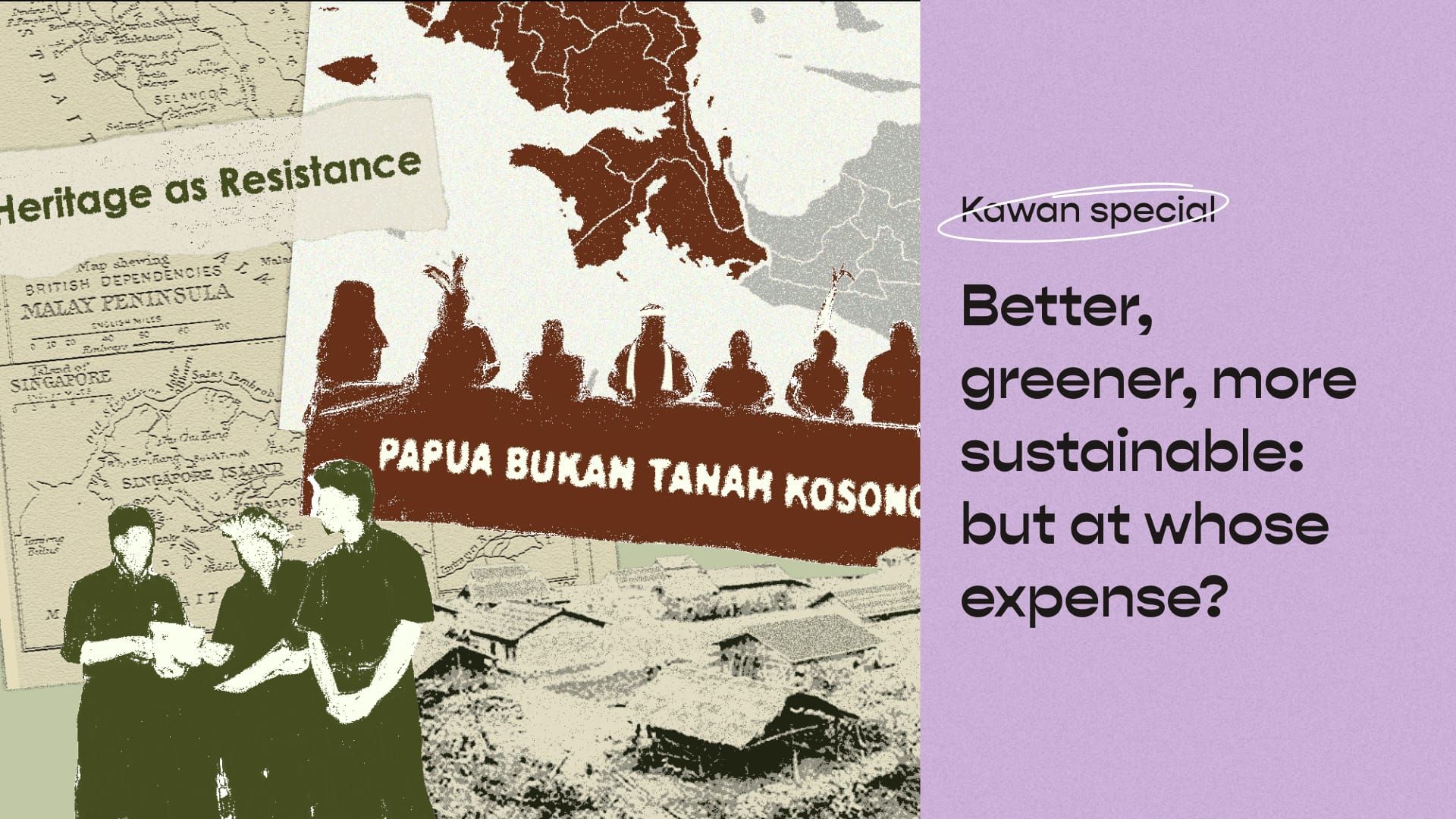
Better, greener, more sustainable: But at whose expense?
We all want a better, greener, and more sustainable future, we also want abundance in agriculture, food production, and natural conservation. But adding the decolonial lens forces us to ask: At whose expense is this better, greener, more sustainable development made possible?
Hi! I’m Kai Hui, a data storyteller at Kontinentalist.
Last April, in my first month joining the team, I (virtually) attended an academic workshop titled "The Future of Land in Asia: Decolonial Perspectives on Agriculture, Food Sovereignty, and Conservation," organised by the Food Politics and Society cluster at the National University of Singapore’s Asia Research Institute.
Before joining Kontinentalist, my work was a mix of research and journalism. My earlier immature academic projects explored the intersection of gender, sexualities, and postcolonial politics in Malaysia. As a journalist, I covered a broad range of topics, including gender, sexualities, culture, environmental issues, and tech ethics.
Since Kontinentalist frequently covers food systems, climate sustainability, and Indigenous struggles, I was curious when I heard about an academic workshop that focuses on using the decolonial lens to examine food, agriculture, and conservation. While I am not a scholar, I spent two days listening to panel discussions by researchers, postgraduate students, and community organisers, hoping to see how their insights might reshape the way we, as a data storytelling alternative media outlet, approach, and represent these big global issues.
Here are three things I learned.
- New green economy might drag an old colonial shadow
For many, colonialism feels like a distant past, and the development of a green economy seems like a hopeful step toward a sustainable future. But look closer, and you might find that even well-intentioned green initiatives can reinforce old, extractive colonial logics.