How do we lay roots in shifting soil: Reflections from Creating Narratives for Change Festival

I’ve been watching a lot of TV shows lately, my recent favourites being Insecure and Abbott Elementary. Both shows take place in predominantly Black neighbourhoods in the United States, forming the backdrops for these characters as they explore their own relationships to their work, friendships, and homes.
Their neighbourhoods and cultures are referenced constantly. In Abbott Elementary, Janine Teagues, an overenthusiastic public school teacher, is shown teaching her students “sight words” using Philadelphia slang. And in an Insecure episode, Issa Rae, playing a voraciously passionate millennial, organises a block party, gathering local community artists and musicians from the actor’s own Southern LA neighbourhood. Both shows seem to skillfully traverse the balance between bringing an outsider into their world, and not overexplaining themselves to viewers.
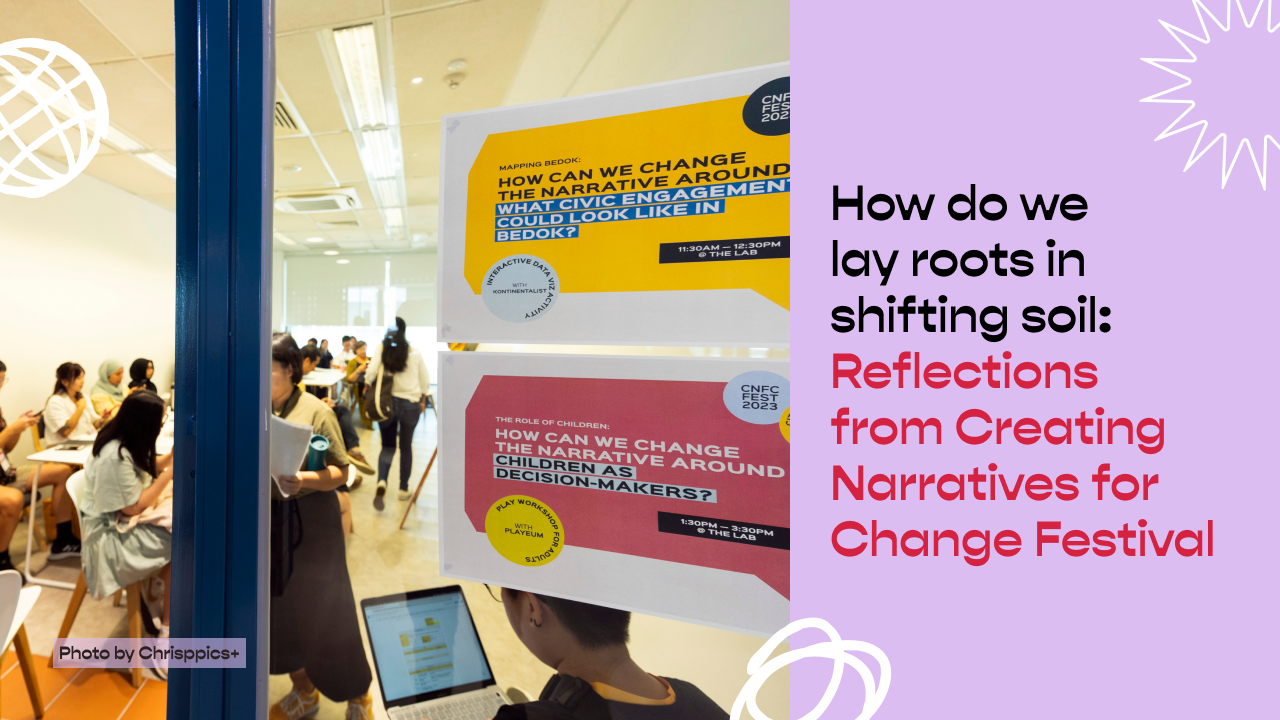
Depicting local stories always brings up important questions, like how do you show authentic stories of localities and the lives of their people, in all their complexities? As an outsider, how do you approach these stories? This balancing act was something I was thinking about in our recent workshop about civic engagement at Common Ground’s Creating Narratives for Change Festival that took place on 16 September. The festival brought together people who wanted to change the way stories are told about their communities or sectors through workshops, conversations, and experiential activities. In fact, our office is actually located at Common Ground, a Bedok-based civic centre and cultural change consultancy! Our workshop was centred around mapping civic life in Bedok—the places where people lived, ate, worked, rested, and hung out with their friends.
As a lifelong west-sider in Singapore, I readily understood my own position as a person trying to gather stories about a neighbourhood in the east that wasn’t really mine. My relationship with Bedok, at this point in time, is that it’s the place where I work. This doesn’t preclude me from forming my own relationship with the neighbourhood, of course. I still have my favourite haunts and eateries, familiar faces of uncles and aunties at the floral shop that I always pass by on my short walks, and an evolving rotation of places to get my caffeine fix from.
Munirah, our visual designer, who worked together with our multimedia designer Griselda to design the maps, has lived in Bedok her entire life. As we planned the session, she recounted stories about her neighbourhood, telling us about a former skate park in the area where she and her primary school friends would watch skaters do fancy tricks under the hot sun, or climb the nearby giant “spider” playground. That area is now the site of a sheltered multi-use community hub: Heartbeat@Bedok. In trying to map the contemporary scene of civic life in Bedok, I was also reminded of its past life and the changes it’s seen.


During a recce of the neighbourhood, I met an uncle running one of the few provision shops located at the back of the hawker centre. The compound is sparse, with metal gates shut tightly in front of most shops. When I asked him why, he shrugged and alluded to familiar reasons: rising rent, and a change in buying patterns. “People these days don’t buy groceries anymore, nobody cooks. They just eat out.” None of these reasons were shocking, yet they took me by surprise. I was also part of the said group of “people these days”, and I was reminded of how the spaces around us continue to respond to the ways we’ve changed as well.


Our team, Darrell, Griselda, Munirah and I, did initially wonder—how do we craft a session about Bedok that caters to participants who might not be from the vicinity? Would they still resonate with our session? But we were pleasantly surprised by the stories that were eventually shared during the session. Those who lived around Bedok shared personal memories of their interactions and experiences with the neighbourhood. Others who weren’t from the area were quick to point out Bedok’s distinctiveness, yet they also saw striking similarities with their own neighbourhoods. Common threads emerged throughout the session, and we loved seeing how people made meaning of their own sense of home in response to another.
When walking back home from the train station after our session, I decided to take the longer route, the one that passes by my primary school—now much bigger, with more and expanded facilities in the school. I was suddenly taken by the memory of my then-principal encouraging us to raise money for a new sports hub for the school. Eventually, it was built, though long after we had graduated, alongside newer compounds of the school. Yet, the main school building still remains, unyielding in the face of multiple school closures and consolidation across the country in the past decade. Moving through our own neighbourhoods in Singapore at times feels exactly like that: a terrain of both unfamiliarity and familiarity, where you are at once both a sojourner and a fixture to a place that is constantly reinventing itself.