Exploring Desire Paths in Singapore
The team behind ‘A line of our own drawing’ shares deeper about their ideas, process, and experiences researching desire paths in Singapore.


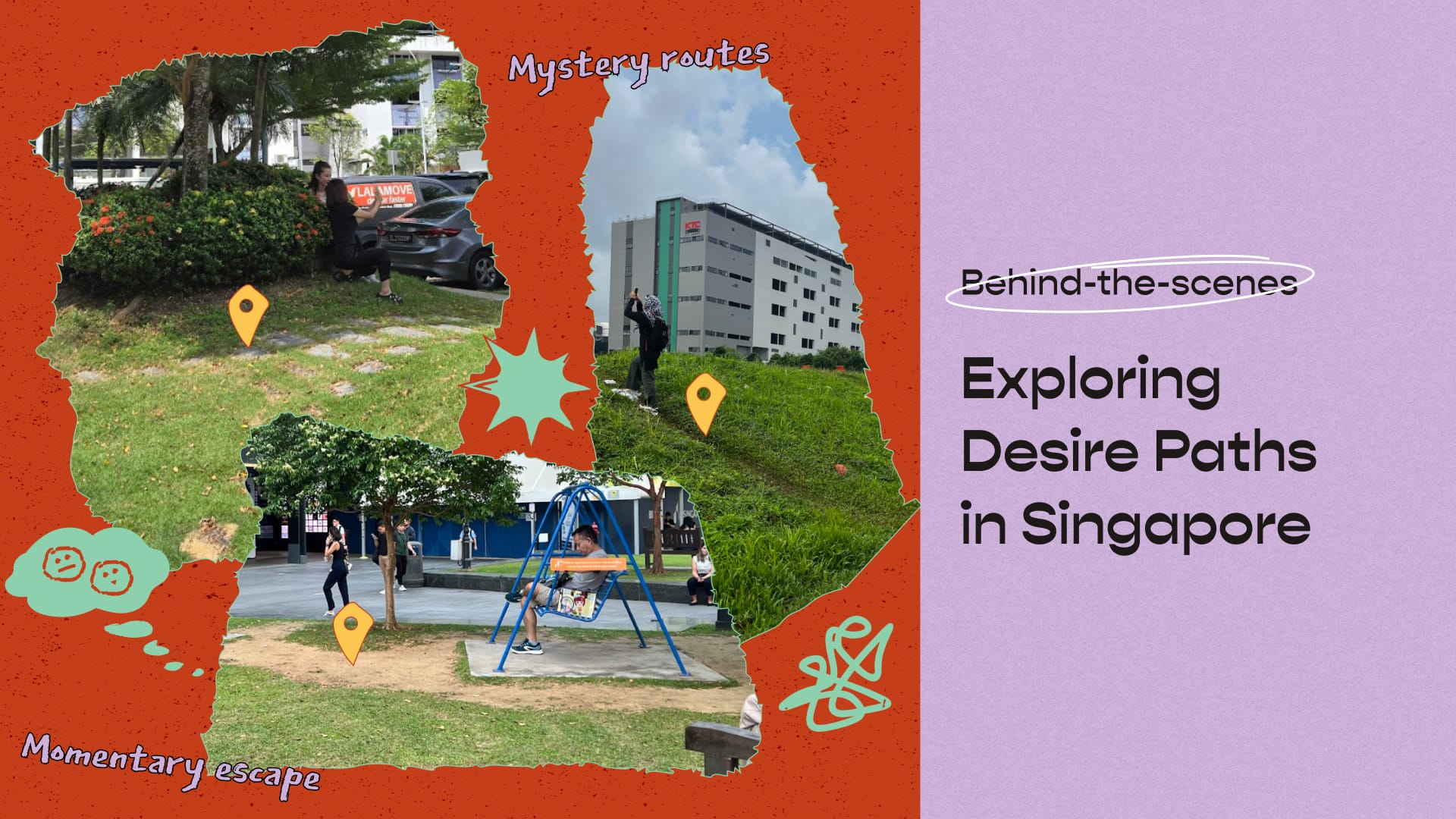
Where do we walk? Why do we walk? Back in April 2025, the Singapore Art Museum (SAM) approached Kontinentalist to create a data work that would respond to walk walk (Singapore Deviation version), an installation work by Singapore artist Tan Pin Pin. In our brainstorm, we explored various ideas—from walking as a form of wayfinding, to walking being a political act, how fast people in cities walk, and how they commute. We eventually landed on “desire paths” as a central idea, which are those informal paths created in grass or dirt patches made by human traffic. This led to the creation of our work, A line of our own drawing.
As we researched more on desire paths, which have different names across different cultures such as “elephant paths” and “desire lines”, we became interested in what they represent. In Singapore, which is known more for its urban planning and manicured landscape, desire paths become examples of disorder and disobedience, and even an exercise of democracy. Inadvertently, these ideas also contrasted sharply with an earlier data work we did with SAM, The Hidden Green, on how nature is carefully managed and curated in Singapore.